
I’ll Believe in Anything (Again): Wolf Parade, Hockey Players, and Canadian Music
I spent the better part of this year longing for the next iteration of Shoresy - a Canadian television show about hockey - and because of this, I completely ignored the first few weeks when Heated Rivalry hit Crave to a tonne of fanfare. I knew that Jacob Tierney, who I knew and loved from 2009’s Trotsky starring another favourite Canadian, Jay Baruchel, was directing it, and from seeing the incredible work he’d done recently with Letterkenny and Shoresy alike, it was definitely on my watchlist. With the “Casual Viewing” phenomenon plaguing streaming services, it’s becoming difficult to find fully emotionally developed characters and honest, open storylines. Vapid, vacant stories with too much exposition and too little payoff seem to be the norm - save for Canadian television - and Canadian art in general.
I quickly devoured the season in two days after the final episode aired - stopping to message my co-worker in Vancouver who had been raving about the series since it started, about Episode 5.
Heated Rivalry is based on the Rachel Reid novel, following the years-long romance between two sets of hockey players in two storylines. While Ilya and Shane (the A Story) are the main plot, it was the B story following Scott Hunter (played by Francois Arnaud) that had me in tears - and the rest of the world.
(Spoilers ahead, figure it out.)
Scott Hunter - closeted and masculine hockey player stuck in a rut - is having a hard time in his career, falls in love with Kip over smoothies and quickly things escalate, they move in together, and Kip’s friend, Elena (an amazing ally), is concerned that Scott is carrying Kip with shame while Scott begins to improve his game. The secrecy of their relationship becomes heavy, and Kip goes home to his father for a heartbreaking welcome home. Our last encounter with them at the end of Episode 3 is Scott standing outside of a bar as he watches Kip celebrate his birthday with his friends.
Episode 5 (which at this writing is tied for Breaking Bad’s “Ozymandias" at a 10.0 on IMDB and has a 100% on Rotten Tomatoes) is interesting as two storylines come to a head incongruently - Ilya can finally confront his feelings about Shane, and soon after, agree to spend time together quietly over the phone, but because of a catalyst that happens with Scott and Kip.
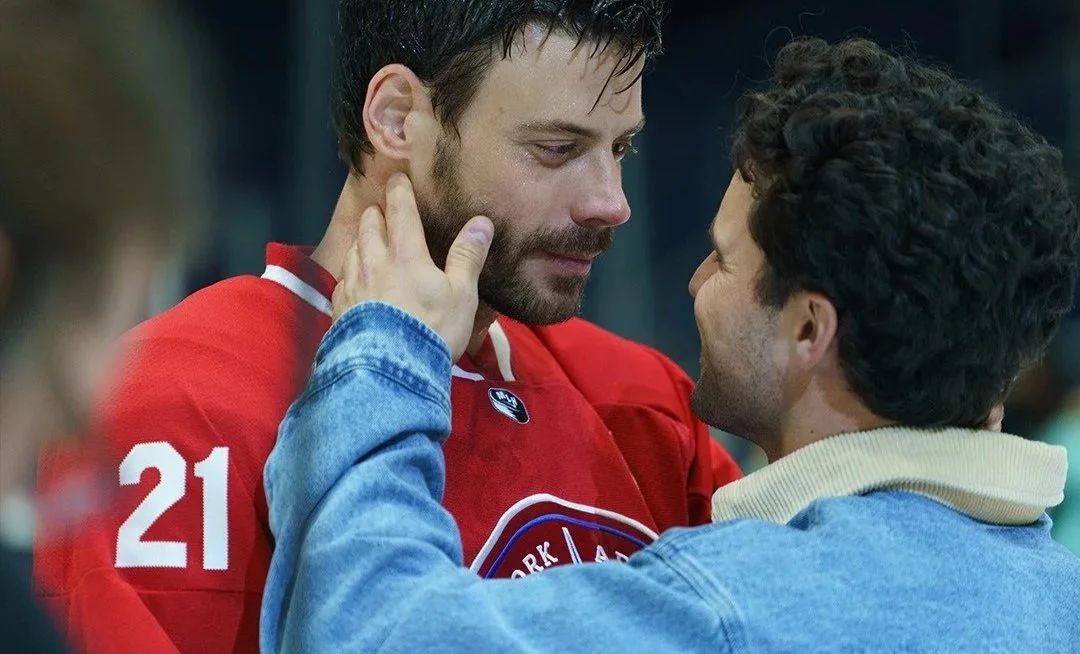
Time has passed, it’s been a few years, and Kip comes to Scott’s MLH winning game where he spots Kip in the crowd, invites him to the ice, and after what feels like eons of yearning, the two kiss in front of everyone. This display gives Ilya the courage to accept Shane’s invitation to the cottage.
And while this is all fine and well (it’s not actually, it’s incredibly emotional and you immediately have the need to go hug the nearest person to you), what I really want to talk about is the last 5 minutes of the episode.
Scott Hunter and the New York Admirals run out the clock, they win the cup, and at the 50:33 mark, Scott hoists the cup in celebration as 30 seconds later, we see Kip in the stands clapping with tears in his eyes. A few seconds later, the opening discordant notes to Wolf Parade’s “I’ll Believe in Anything” begin to play.
The players hug their loved ones and each other. Scott has no one to hug as he nods and acknowledges his team, the sound of the crowd begins to fade as the song begins to take control of the soundscape, the drums heavy against the vocals. Scott sees Kip, and Ilya is packing his suitcase. Scott calls Kip down to the rink as Ilya and Shane watch from their home.
The Lyrics belt out “I’d take you where nobody knows you / where nobody gives a damn” as the announcers try to figure out what Scott is doing, and when Scott finally has Kip’s hand on the ice, the lyrics continue “And if I could give you my apologies / by handing over all the olive trees”.
They kiss and declare their love to everyone during the iconic chorus of the song, which drops out just long enough for Ilya to confirm he’s coming to the cottage before leading us to the credits, where the song kicks back in, full sound.
Wolf Parade is a band out of Montreal. Their first album, “Apologies to Queen Mary,” came out in 2005 to the fanfare of Pitchfork and made a notable space alongside contemporaries like Arcade Fire and Modest Mouse at the time, while cementing their place in Montreal’s Indie Music Scene of the 2000s. Rebecca Raber writes of the album for the 89th spot for Pitchfork’s Top 200 albums of the 2000s
“Few songwriters could be responsible for both the bouncing neon synths and David Bowie warble of ‘I’ll Believe in Anything' and the swaggering slow-burn and breathy, Bruce Springsteen-ish croon of ‘This Heart’s on Fire', but Wolf Parade prove that one band certainly could be.”
The band has since released a few more albums, lost a few members, gone on hiatus, and then returned with their most recent work in 2020, following the viral success of this Heated Rivalry scene around the world. It’s near inescapable on TikTok and Instagram, with countless users with content related to Heated Rivalry using the song in their videos. The song, 20 years later, is charting on Spotify with a generation of kids looking for the feeling this song gave us over the airwaves of 102.1 The Edge.
Jacob Tierney knew what he was doing, putting this song, from what feels like a local Canadian band from 20 years ago, on a worldwide stage. In a podcast interview for the What Chaos! Show, Tierny describes the work that went into that choice of song:
“What I knew I wouldn’t get with Shane and Ilya was this big fucking huge release, and I wanted that … Their victory is small, it’s quiet … [The Scott and Kip scene] was scripted so heavily because I knew it was going to be that song … I cleared that song months before shooting because I was like I built this whole fucking episode, this whole two episode around this one Wolf Parade song and I need it. And if it’s going to be different, I have dialogue to change, I used the word ‘sunshine’ over and over again, I’m doing all these things on purpose because I want this to feel as big a fucking gut punch swell as I can do. And that’s my favourite song. And I was like this all has to be in place at once … This has to feel like an opera, this has to feel as big as it can possibly fucking feel. … That is as much of my heart as I could put into anything.”
There’s something about Canadian music that has the universality to make it feel like it’s from anywhere and about anything. Nick Mount asks, “How does the local become the universal? So I’m really not sure about this, but I think the best answer a writer or artist could give to that question is ‘don’t know, don’t care’ because I think for the writer or artist, doesn’t matter where you are, getting the local right is enough. That it’s enough to be true to the feelings that you have for the place that you know, because places are not universal, but feelings are.” It’s the same way you feel driving through small towns when you hear The Tragically Hip’s Bobcaygeon, or The Weakerthans’ Tournament of Hearts. The music from here isn’t always about the space; it’s about yearning, leaving, and coming home.
What makes this moment even more distinctly Canadian is that the universality of the song was never intentional. In a December 2025 interview with The Globe and Mail, Spencer Krug, a founding member of Wolf Parade, admits that I’ll Believe in Anything feels like it was written by “another person.” He describes the song as something he released and then let go of, explaining that once music is put into the world, “you let it do its thing.” The emotional freight the song now carries was never planned, curated, and even now, not reclaimed in any way 20 years later.
Northrop Frye wrote in the Literary History of Canada from 1965, that Canadian literature was defined by “Garrison Mentality” - the idea that Canadian settlers spent so much time keeping shit out (winter, enemies, nature in general) that our stories are based on survival and endurance. Frye thought this was a dumb way to define our art, but it’s this very thing - the need to connect despite the vastness of our geography through our stories of existence, despite our surroundings.
I think all songs built by Canadians, in some way, shape or form, carry this as a through line. Don’t believe me? I can make a great case for Justin Bieber’s Baby being about loss of place and yearning for home (the ‘baby’ in question). I don’t think I could do it with B4-4’s Get Down, though.
In all seriousness, there’s something about the music of that time that you can’t necessarily define, but you know. The early 2000s saw bands like Broken Social Scene from Toronto and Arcade Fire from Montreal, and a myriad of then-local acts that looked at indie rock and defined it as something new and different. Truly independent, they were free to create soundscapes that were genuine to the zeitgeist. I remember spending weeknights at the Horseshoe Tavern and the Rivoli in Toronto, listening to anyhow bands sing into staticky mics and play out-of-tune guitars - and never once feeling like you were the only one. In a group of sweaty, angst-fuelled teenagers, you were all cut from the same cloth. That need for connection happened in real time, physically and tangibly, as everyone reacted to the same repressed feelings in the room, driven by emotion and survival more than anything else.
In Canada, we had to watch 9/11 happen, live through the threat of Y2K, see an economic recession, and came to grips that the world was falling apart and it was quickly becoming our problem. This frustration and liminal space, where we felt powerless and powerful, defined the music being made in garages and basements.
These bands focused on getting the local right, as they played songs that were discordant and cacophanous, but still, emotionally, from right here. Canadian music is uniquely built to this kind of emotional universality because it is so rarely built to be the centre focus. As the Massey Report in the 40s suggested, Canada is so vast and massive, being the centre isn’t the goal. Existing alongside influences from the U.S., Canadian art has historically been made of the overheard and the unannounced. This creates songs that are porous, never declarative, and wait to be filled with someone else’s longing.
Wolf Parade is no different. I’ll Believe in Anything, at first glance, is a love song. It’s one, yearning for another, and idealizing a place where they can be together, where no one knows who they are - a near-perfect catalyst for the meaning that Tierney was chasing.
Taking a look at good old Song Meanings offers 156 interpretations for these lyrics by folks across the globe that love this song, as far back as 21 years ago. These folks see the song not just as a love song, but something that mirrors someone going through addiction, or a song akin to Death Cab for Cutie’s I’ll Follow You into the Dark about loss and grief.
And at its heart, the song is comprised of two repeating parts. It opens with a two-note discordant synth that plays noise until a heavy drum kit beat comes in to bring order to the noise. The guitar comes through with an easy melody, catchy as the vocals mirror the pattern. I remember hearing this on the radio and having this riff stuck in my head for days at a time.
The song, according to the band, is in fact about love. Krug wrote a history of the song on his Patreon and published a snippet to his Instagram:
“... At the time, I wasn’t trying to make anything rock’n’roll, or epic. I was just making another one of my kooky piano songs. For me, it was a scrappy little love song about two people willing to take a chance on their young relationship, even though they’d already screwed up a little bit and its chances of survival were slim. If the singer could just settle down, face the reality of their love, then maybe they could settle down together (“If I could take the fire out from the wire / I’d share a life…”). Maybe they could / should even go somewhere new, start fresh, where nobody knows them. Love is worth trying for, kind of thing. I recorded it with some shitty mics onto my computer, added some loose yet relentless hand claps, and called it a song.”
The song is, however, cathartic. It has a huge release that makes you wait for relief through the runout. It’s relentless with its ebbs and flows, its sound is messy and dirty and the sound that can only be created in the face of the early 2000s in a basement. It’s a song that places emotion and creativity before commercialism, and forefronts the need to create connection in a space that is damaged and broken. This song didn’t become meaningful because it went viral thanks to two gay hockey players; the song already knew how to carry meaning.
Pitchfork’s original 2005 review of Apologies to the Queen Mary, Brandon Stosuy singles out “I’ll Believe in Anything” as one of the record’s emotional anchors. The song is described as both “anthemic and fragile”, driven by a vocal performance that feels like it might collapse under the weight of its own feeling at any moment. Stosuy reads that the song sounds desperate and moves with conviction and uncertainty. It thrives on that feeling of too much, of overwhelm, but the honesty of the lyrics never trespasses into indulgence. Instead, it’s an earned feeling - an emotional release valve that has you running towards something you don’t understand but you feel. This makes sense as to why Tierney would choose this particular moment to fit this amount of the song into this episode.
Krug’s indifference to authorship, Tierney’s quest for Catharsis, and Mount’s insistence that “getting the local right is enough” all point to the same Canadian artistic theory: universality is not pursued; it just happens. Tierney says, “I think I can make a moment feel like this, I really feel like if I can use all the stuff I’ve learned and like all the experience that I’ve had, of like what works and what comes together to do something. And I got the song, and I got the thing, and I’m glad people like it as much as I like it.” I’ll Believe in Anything ends in the same way that Heated Rivalry does, and so many other Canadian narratives do - not with a hard and fast resolution, but with motion and emotion - leaving and choosing to stay, believing that connection is what makes it worth it to stay where you’re at, regardless of external.
Crave announces that episode 5 is the highest rewatched episode of the series.