
ISO: West 49, Circa 2006
After months of searching, I found it.
On the website of a family-run shoe shop in Alberta, I found it.
A black zip-up hoodie, for women, shorter than the standard unisex or men’s fit, with a tasteful graphic on the back.
Just like the one I bought, twenty years ago.
I’ve been on the hunt for a hoodie for a few days now. Not a stylish Lululemon scuba hoodie, or a novelty Harvard hoodie, or whatever the latest rag-tag group of teenage influencers are currently marketing to the over-30 crowd as a way to reclaim our youth.
I’m looking for a skate hoodie. The kind you could get at West 49 in Yorkdale Mall circa 2006. Roxy hoodies with a hidden emblem embroidered on the chest in fuchsia, black, or turquoise. Element hoodies with thumb holes stitched so thick I could trace them over and over with my fingers. Billabong hoodies with slouchy shoulders that made you look like you were headed to a beach in California, when really it was minus twelve in midtown Toronto.
It’s felt impossible to find.
Sure, you can find a standard cotton zip hoodie for fifty-four Canadian dollars if you’re lucky. Shitty cotton that turns to mulch in the wash. Seams that fray within months, rubbed thin by your hands worrying the inside of the pockets until the stitching gives way. I can find a pullover hoodie with some obscure branding in a pinch - a played-up Gildan monstrosity for over two hundred dollars. But gone are the days of skate hoodies emblazoned with DC, Circa, Element, Billabong, and the rest, as the standard.
You can still find the men’s versions in shops - large, oversized, awkward. Your arms feel too small, too short inside them. But nothing felt better than a broken-in women’s hoodie, soft cotton fresh out of the dryer. Comfort. Safety. Sleeves just long enough to pull over your palms when you need the extra support.
It was a symbol of our time.
You wore a hoodie over a band T-shirt, skinny jeans, and Chuck Taylors. It was formal wear. It was a uniform. In the dead of summer, you tied it around your waist or stuffed it into your knapsack. In winter, you wore them big and heavy; in summer, light and soft. There was no greater expression of love than loaning your favourite one to someone in need, even if only for a few minutes.
Lately, I find myself longing for the simplicity of high school: hearing the opening notes of Sweet Disposition for the first time and leaning my head against the open windows of old streetcars while Chicago blasted in my headphones like the score to a movie. Scoring my own version of a 2000s coming-of-age film as I moved through the city, amped up on caffeine and spite.
It feels like things are moving backwards all the time. All-American Rejects playing backyards and fields. Hayley Williams is putting out music. Bands like True Blood - a collection of adolescent boys are fueling their feelings into covers of indie songs in their garage - are becoming cool again, and it feels like it could be 2008 all over again. And I think, with our days comprised of unprecedented events every goddamn day, with the world falling apart from the heat of data centres, and being on the brink of World War Three while we all struggle to live under the crippling anxieties of adulthood, the more and more we’re retreating to the freedom that we had when we were young.
It’s now that we need Jimmy Eat World asking if we’re listening, The Shins talking about the whole mess of roads we’re now on. We found what freedom looked like - waiting in skinny jeans and soaking-wet Chuck Taylors in lines outside the Dakota Tavern, the Garrison, the Drake Underground, Upstairs at Sneaky Dee’s, dancing in a group of sweaty young people who were all, for just a few moments, understood.
I think this is the real recession indicator - millennials forced into adulthood, still feeling like we’re inherently sixteen years old. We’re filling our homes and our closets with nostalgia. We play the songs, watch the movies, pad our Vans with insoles, trade our Chucks for designer versions (high top Comme Des Garçons that I now consider my formal shoes), but we still turn to the same songs and moments again and again.
The hoodie itself is a perfect example. Worn by the antiheros and nerd - Seth from The OC, Chuck from NBC’s Chuck (RIP to Lovable Zachary Levi) and most importantly, Andrew Largeman from the greatest coming of age film of little Manic Pixie Dream kids everywhere, Garden State.
I don't give a shit who you are, the moment you saw Garden State for the first time, either with your friends, or with the person you were dating, or your significant other dragged you to see it, or you asked somebody you knew in passing to go watch it with you just so you had an excuse to feel their body heat against yours in the silence of a dark theatre, or even watching it alone under your covers on a laptop in the middle of the night, you remembered how to breathe deeply for the first time in a long time. Watching Sam and Andrew kiss through longing tears while the outro to the haunting-sounding violin pick-ups and pithy electronic beats of Frou Frou's Let Go signals a future of possibilities, even when Twitter tells you otherwise in 2026.
Garden State has always been a movie that lets me sit in my feelings, looking at two broken people coming together. Andrew, a struggling actor, comes home for his mother's funeral and meets Sam, an eccentric Manic Pixie Dream Girl Prototype, in a doctor's office. They meet-cute over a dog humping Andrew's leg and Sam showing him The Shins, Andrew clad in a grey hoodie, soft, secure, and safe, and you watch these two people peel back their brokenness layer by layer until they piece together something more whole than the two of them combined.
Much like a lot of the films of that time - Nick (a very young Michael Cera) following Norah (a very young Kat Dennings) around the city all night, falling in love to music and moments in Nick and Norah’s Infinite Playlist, Summer and Tom playing house in Ikea in (500) Days of Summer, Devon Wright (a more wholesome Nick Cannon of 2002) chatting up Laila in that blue sweater in Drum Line, even Megan Fox draped in a pink cropped sweater seducing the men she devours in Jennifer’s Body, were draped in the music and the culture of that time, alternative music and movies and representation of youth.
That’s the chameleon nature of the hoodie. Worn by culturemakers throughout history, athletes, musicians, and artists, the diversity of the hoodie is universal. Worn for fashion or function, the hood provides comfort, warmth, and, in some cases, anonymity. I remember hiding under my favourite hoodie, a plum purple Element hoodie I found in a TJ Maxx while on a vacation in Philadelphia for a whopping clearance price of 9.99 USD in 2006. It was soft, washed until the threads frayed at the sleeves, the thumb holes stitching worn smooth from tracing the shape of them again and again, the zip gliding up and down with constant use that it moved with such ease, the pockets slouchy from the force of hands jammed into them again and again, wringing the fabric when uncomfortable, which as a teenager, was constant.
For a self-conscious teenage body, the hoodie meant camouflage. Hiding in plain sight. Pulling the hood over a bad dye job, a zit, eyeliner applied too thick after hours of trying to get it right.
While the hoodie provided an oasis during adolescent social interactions, it also carries the connotations of counterculture that became deeply politicized. Eight years ago, Paola Antonelli curated the show “Items: Is Fashion Modern” At MoMA. Speaking to SSENSE UK about a red Champion hoodie on display, she said, “If you think about it, [t]he hoodie was everything we needed it to be. It’s global, it’s a great design, but also it’s become this tragic political symbol”. She’s speaking, of course, of the racial profiling and the murder of Trayvon Martin.
Darnell Hunt, a Sociologist at UCLA, was quoted in Katherine Boyle’s Washington Post article on hoodies in the wake of Trayvon Martin’s death in 2012. He wrote, “Most pieces of material culture have symbolic qualities associated with them… The hoodie is a pretty generic piece of clothing, but because of the contexts and the groups it’s associated with, it took on different meanings. Just like sagging pants, it was a macho, street-swagger symbol of hip-hop culture, even though it originated in medieval Europe.”
Boyle continues, quoting Denis Wilson, who noticed the hoodie’s symbolic evolution in 2006 after being asked if he was “trying to be a gangster” for wearing one to a nightclub. “Because I’m white, I thought the hoodie was skater,” Wilson said. “But I went back through the history, and I saw the shift when graffiti artists used it to shroud themselves when tagging trains. There’s a connection to the more violent overtones of hip-hop. To ignore the violence in NWA and 50 Cent is silly, but it’s absolutely stupid to think of the hoodie as dangerous. There are hoodies made for nursing mothers.”
And we know this. We know that the hoodie belongs to everyone, not with any nefarious behaviours, but instead as a way of showing up for yourself authentically. We can’t all be Andrew Largeman listening to the Shins for the first time. The hoodie is not neutral. It never has been. What was safety for some became suspicion for others. The same garment that let teenagers disappear into themselves became a justification for violence. After Trayvon Martin was killed, the hoodie stopped being just a comfort object and became a symbol, politicized and weaponized in ways it never asked to be. A piece of clothing does not pull a trigger, but it can be made to carry fear and projection at the same time. Loving the hoodie means holding that truth alongside everything else it has been.
The hoodie was synonymous with growing up in the 2000s. It didn’t matter what your clique was. Everyone had one in their closet. Skaters, band kids, drama kids, kids who didn’t quite fit anywhere yet. It was the one thing we all reached for. A uniform, a shield, a soft place to land.
That’s why losing it feels like losing more than a piece of clothing. The disappearance of the skate hoodie is the disappearance of something gentler. Something made to be worn into the ground. Something meant to absorb nervous energy, bad days, late nights, long walks home. The hoodie held our hands when we didn’t know what to do with them in ripped thumb holes and kangaroo pockets. It hid us when being seen felt like too much. It gave us somewhere to go when we couldn’t articulate why everything felt so heavy all the time.
The hoodie became shorthand in all of the culture that I grew up with - the uniform of quiet protagonists. In Garden State, Andrew moves through grief and medicated numbness wrapped in soft cotton, withdrawn rather than defiant. In Nick and Norah’s Infinite Playlist, the hoodie makes the city survivable at night, worn between venues and disappointments, music loud enough to keep you upright. In (500) Days of Summer, heartbreak happens in hoodies, quietly, without witnesses. And in Jennifer’s Body, even amid hyper-visibility and spectacle, the hoodie belongs to the girl who refuses the gaze altogether. In Drumline, Devon’s ambition and pride are contained in the confines of that hoodie, long hours of hard work draped in some cotton. The local band from Newmarket, tearing it up on the stage of the Rivoli in black hoodies over CBC t-shirts. These weren’t costumes. They were coping mechanisms.
And then, after months of searching, I found it. When it arrived, my hands instinctively found the pockets. The fabric gave in familiar ways. Soft where it needed to be. Substantial enough to feel real. And now, as I sit here writing this, the hood pulled up over my head, the Garden State soundtrack in my ears, I feel something settle.
Outside, everything feels loud and unmanageable. The world is burning, politically and literally. The news cycles faster than I can keep up with. Adulthood presses in from every direction. But inside this sweater, I am safe. Contained. Held together.
Maybe that’s what we’ve been chasing all along. Not youth exactly, but the feeling of being protected while becoming ourselves. The hoodie didn’t just witness our coming of age. It helped us survive it.
And sometimes, it still does.
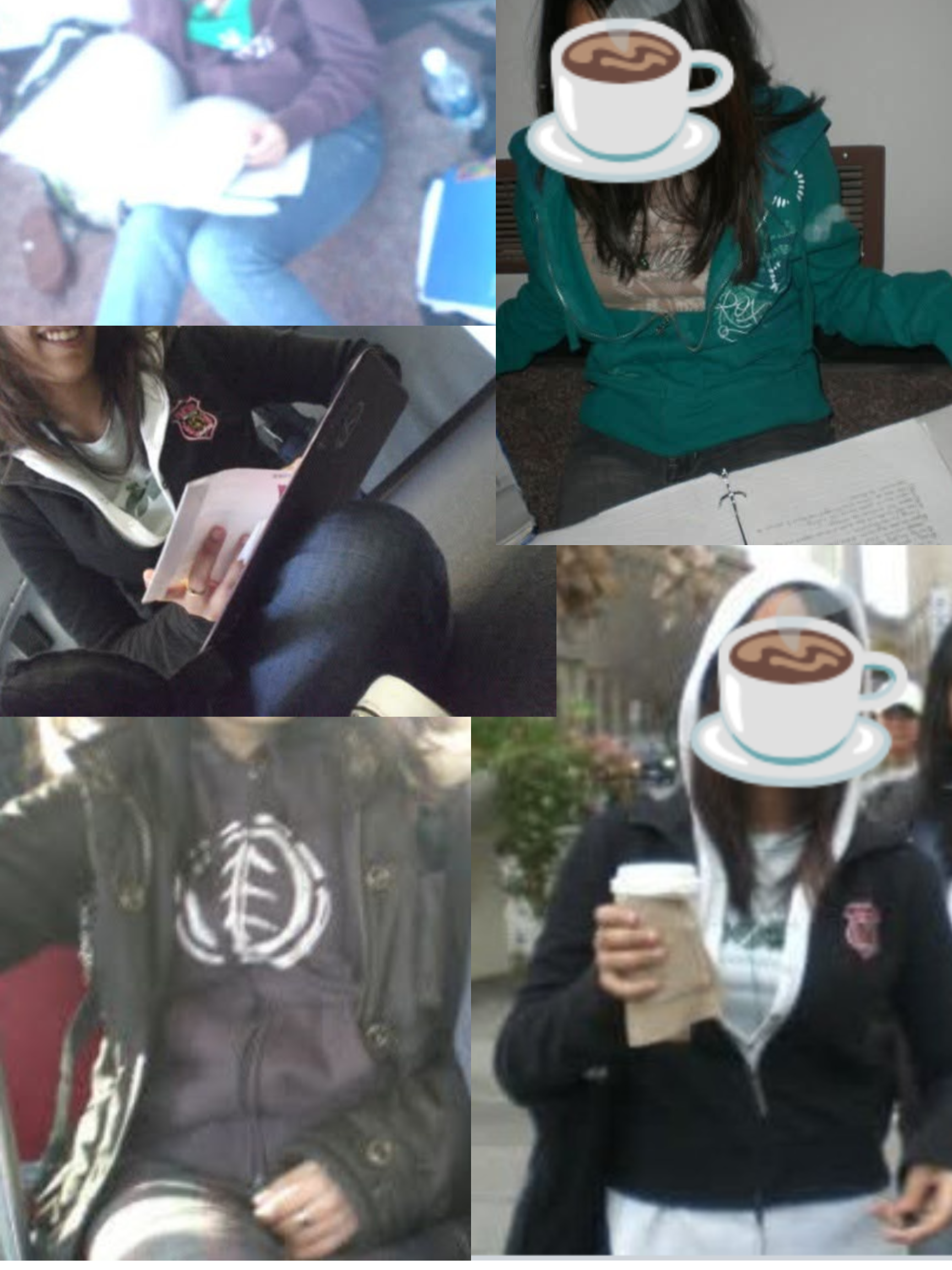
A collection of hoodies - 2006-20